


Discover extended content labels, how they work, and how they help brands combine regulatory compliance with marketing communication and consumer expectations.
Every square centimetre of a product label matters. As regulations become increasingly complex and consumers demand greater transparency, a single printed layer is often no longer sufficient to carry all required information.
This is where extended content labels come into play. These advanced labelling solutions give brands the space to communicate everything they must – regulatory, legal, and safety information – while still presenting everything they want, from branding and storytelling to sustainability messaging.
In this article, we explain what extended content labels (ECLs) are, how they are constructed, the different types available, and why they have become essential across industries ranging from pharmaceuticals to food and cosmetics.
What are extended content labels?
Extended content labels (also known as multi-layer labels) are self-adhesive labels designed to provide additional printable space without increasing the size of the packaging.
Instead of reducing font size or compromising visual design, extended content labels expand the available area by incorporating multiple printed layers that can be folded, peeled back, or removed. This allows brands to include large volumes of information while maintaining a clean and readable front-facing design.
Extended content labels are commonly used to present:
- regulatory and safety information,
- multilingual translations,
- instructions for use or dosage guides,
- promotional codes, coupons, or competitions,
- brand stories, sustainability information, or QR codes.
Why brands use extended content labels
As packaging design evolves, so do its challenges. Extended content labels address several critical issues faced by modern brands.
- Regulatory pressure. Manufacturers are required to provide increasingly detailed information, often in multiple languages and formats.
- Limited label space. Small containers, curved surfaces, or travel-sized products offer very little room for extended content.
- Global distribution. Brands operating across multiple markets must comply with varying labelling standards within a single production cycle.
- Design integrity. Overcrowded labels reduce readability and weaken brand presentation.
Extended content labelling provides a practical solution to all of these challenges, without sacrificing aesthetics or usability.
Types of extended content labels
Modern packaging often requires large volumes of information to be communicated within a limited surface area. Extended content label solutions are designed to meet this need. Below are the most common types and their defining characteristics.
Booklet labels
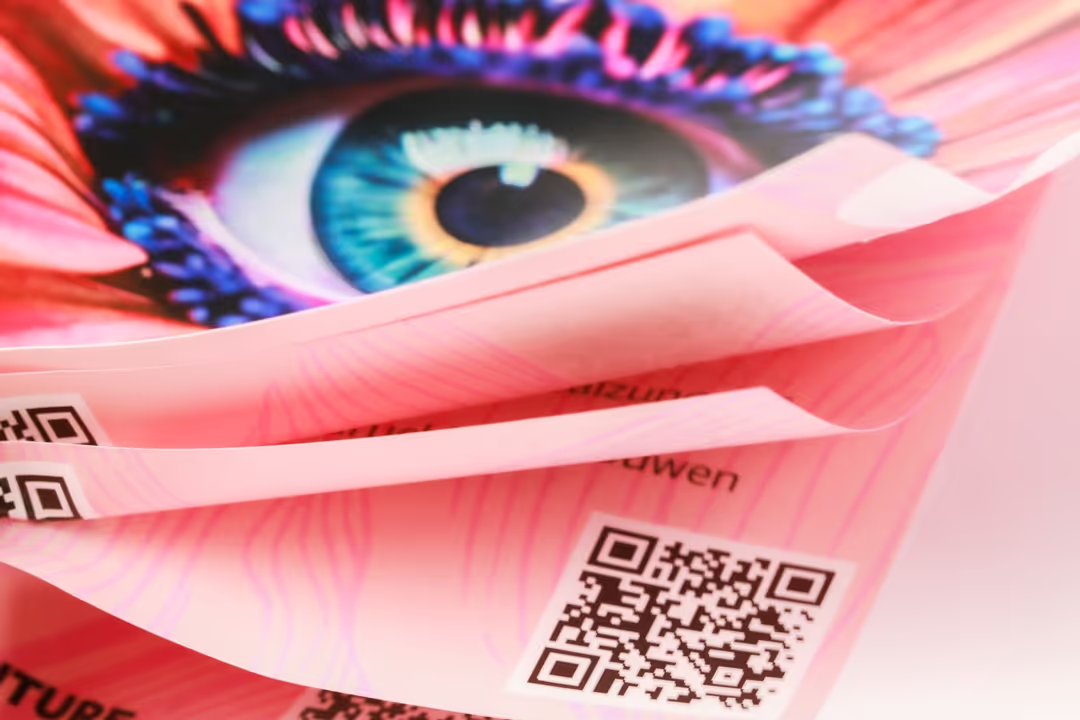
Booklet labels are a type of extended content label that resemble miniature booklets permanently attached to the packaging.
They consist of multiple printed panels – often in the form of folded, glued, or stitched leaflets – fixed to a single self-adhesive base layer. A transparent or printed laminate cover protects the internal pages while allowing the label to be opened and closed repeatedly.
Structure and materials
A typical booklet label consists of:
- a base label featuring the main product branding and adhesive layer;
- a multi-page insert printed on lightweight paper, folded or bound along the spine; and
- a printed or transparent laminate that bonds the insert to the base label.
Content capacity
Depending on label size and folding method, booklet labels can contain inserts of up to 16 pages, comparable to a substantial leaflet. Despite this capacity, they adhere securely even to curved surfaces.
Booklet labels can also incorporate additional elements such as temporary tattoos, sachets, samples, maps, or collectible stickers.
Applications
Booklet labels are widely used as extended content labels for:
- pharmaceuticals – dosage instructions, multilingual text, and patient information leaflets;
- chemicals and agrochemicals – safety data, hazard warnings, and GHS pictograms;
- cosmetics and personal care – ingredient disclosure and multi-region regulatory compliance;
- food products – promotional campaigns and consumer engagement initiatives.
Advantages of booklet labels
- Their primary advantage is the ability to include significantly more information than traditional labels on the same, or even a smaller, packaging surface.
- The outer laminate protects the content from damage while ensuring durability throughout the product lifecycle.
- Thanks to their construction, booklet labels can be opened and closed repeatedly, often without tearing or degradation.
- They can be produced in various shapes and sizes and adhere reliably to curved packaging such as bottles.
- They replace separate leaflets, instructions, or carton inserts, reducing packaging costs and warehouse complexity.
- They can be printed with Braille, making them suitable for pharmaceutical applications.
Disadvantages of booklet labels
- Although many booklet labels can be applied automatically, their thicker and stiffer construction – particularly with higher page counts – can place greater demands on labelling machinery.
- They are not suitable for products exposed to very high humidity, as paper inserts may absorb moisture.
Peel-off labels
Peel-off labels are one of the most widely used extended content label solutions in fast-moving consumer goods packaging.
Also known as ‘peel-back’, ‘smooth-peel’, or ‘peel and read’ labels, they feature a hinged construction that opens like a page, revealing additional printed panels beneath.

Structure and materials
Peel-off labels typically consist of:
- a base label with permanent adhesive, selectively coated with a release agent; and
- a hinged top layer printed on both sides, with selectively neutralised adhesive at the peel-start point.
A peel-off label can include up to six layers.
Content capacity and space efficiency
Peel-off labels can provide up to 1,100% more printable surface area than a standard single-layer label, offering up to 11 panels of text and graphics on the same footprint.
This makes them an efficient way to extend content without altering container dimensions.
Applications
Peel-off labels are commonly used as extended content labels for:
- FMCG products – multilingual ingredient lists, promotions, and loyalty programmes;
- over-the-counter healthcare products – usage guidance and safety warnings;
- food and beverages – recipes, competitions, and sustainability narratives.
Advantages of peel-off labels
- They offer substantially more printable space than conventional self-adhesive labels.
- They are less complex to manufacture than booklet labels, resulting in lower unit costs.
- They are designed to allow repeated peeling and re-adhering of the top layer, supporting usability throughout the product’s life.
Disadvantages of peel-off labels
- The peel-start area must remain visible and accessible, which can slightly affect the label’s visual purity.
- With more than two layers, separation can become more difficult for the end user.
Choosing between booklet and peel-off labels, but not sure which is right for you? Check the linked article!
Dry-peel and coupon labels
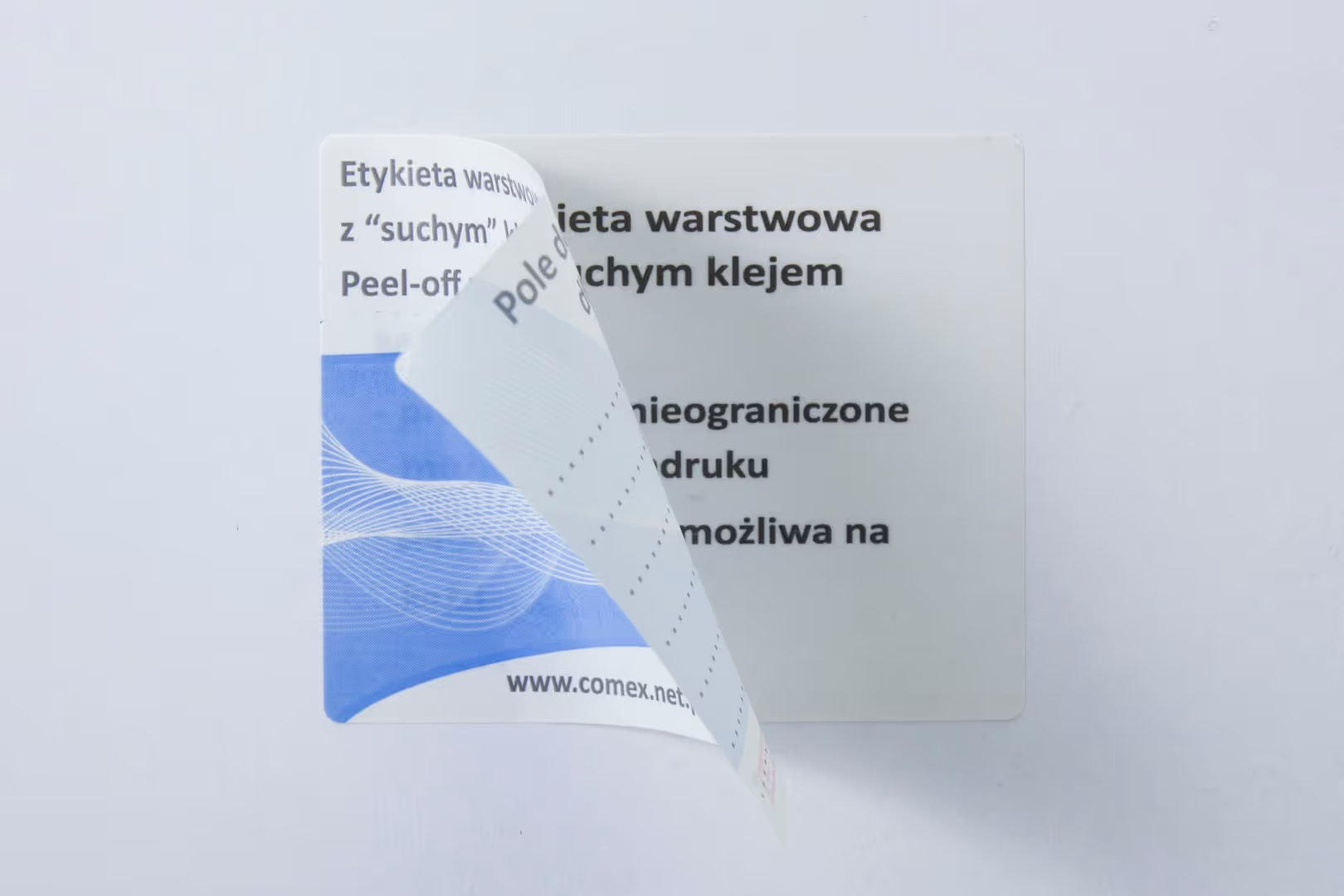
Dry-peel labels are an interactive form of extended content labelling designed to detach cleanly from the packaging surface without leaving adhesive residue.
The top layer can be fully removed, making these labels ideal for promotional and functional applications such as coupons or instant-win campaigns.
Structure and materials
Dry-peel and coupon labels typically consist of:
- a release liner with a non-stick coating; and
- a removable top layer carrying printed information, barcodes, or promotional codes.
Applications
Dry-peel labels are often used as extended content labels for:
- retail promotions – coupons, loyalty codes, and limited-time offers;
- pharmaceuticals – detachable patient information or sample tracking;
- industrial products – identification labels and inspection records.
Advantages of dry-peel labels
- The top layer detaches cleanly, leaving no sticky residue on the product or the consumer’s hands.
- The removed element becomes a convenient information carrier that can be stored or attached to documentation, making it ideal as a discount coupon, ticket, or identifier.
- Dry-peel labels can be applied using standard labelling equipment with minimal adjustments.
Disadvantages of dry-peel labels
- They do not ensure that critical information remains permanently attached to the product and are therefore unsuitable for mandatory safety or regulatory content.
Key benefits of extended content labels
Regulatory compliance without compromise
Regulatory requirements across industries continue to expand, demanding more space for text, symbols, and multilingual information.
Extended content labels allow brands to present complex regulatory information clearly, without reducing font size or overcrowding the design.
Rather than compressing text onto a flat label, brands can dedicate entire panels or pages to ingredients, dosage instructions, hazard warnings, or recycling information, while maintaining a clean and attractive front layer.
Examples:
- A pharmaceutical booklet label can replace the product label, patient leaflet, and carton insert.
- A cosmetics manufacturer can meet both EU and US regulatory standards using a single extended content label format, reducing SKU complexity.
Expanded marketing opportunities
When space is no longer a limitation, the label becomes a storytelling platform rather than a static surface.
Extended content labels enable marketers to include:
- brand heritage stories and craftsmanship details;
- recipes, tutorials, or product pairing suggestions;
- sustainability credentials and sourcing information;
- QR codes linking to digital campaigns, videos, or loyalty programmes.
For premium products, the act of opening the label itself becomes part of the brand experience – a tactile, engaging interaction that strengthens consumer connection.
Reduced packaging waste
Traditional methods of conveying extended information – such as leaflets, boxes, or multiple inserts – increase material usage and logistical complexity.
Extended content labels consolidate these components into a single, efficient solution, reducing paper waste, transport volume, and environmental impact.
Sustainability benefits include:
- elimination of separate printed leaflets or multilingual cartons;
- lower transport weight per unit;
- simplified recycling through mono-material construction (applicable to specific material combinations).
Streamlined global distribution
For international brands, extended content labels simplify compliance and production across multiple markets.
Instead of producing separate labels for each region, a single extended content label can include all required languages, units of measurement, and regulatory variants.
This results in:
- fewer print runs and fewer SKUs;
- consistent global brand presentation;
- faster response to regulatory or artwork changes.
Design and usability considerations
To ensure optimal performance of extended content labels, consider the following at the design stage:
- Material compatibility: match adhesives and substrates to container shape and environment, such as curved glass, HDPE, or metal.
- User experience: ensure the label can be opened, read, and reclosed easily.
- Environmental exposure: account for heat, humidity, and abrasion when selecting laminates and inks.
Early collaboration with an experienced self-adhesive label printing house can prevent costly reprints and compliance delays.
Final thoughts
Looking for a partner with expertise in extended content label printing?
→ Contact us!
Extended content labels represent a key evolution in packaging communication. They bridge the gap between regulatory necessity and brand creativity, allowing businesses to meet legal obligations and marketing ambitions on the same surface.
By choosing extended content labelling, brands do more than solve a compliance challenge. They create a smarter, more efficient, and more sustainable way to communicate with consumers.